


Eden Walks Blog
Things to do in Rome
Things to do in Rome
From Ancient Rome to the Renaissance The Rise of African Excellence
When people think of Ancient Rome, they often picture a civilization centered on Italy. Yet Rome was never simply an Italian empire. At its height, it stretched across three continents Europe, Africa, and Asia bringing together people from countless cultures under one political system.
Among its most prosperous and influential regions was Roman North Africa, encompassing parts of modern day Libya, Tunisia, Algeria, and Morocco. It supplied the grain that fed the city of Rome, produced some of the empire’s greatest writers, philosophers, generals, and emperors, and remained one of the Mediterranean’s leading centers of culture and learning for centuries.
The history of African Romans is not a forgotten footnote it is an integral part of the story of Rome itself. From the Roman Republic to the height of the Empire, men and women from North Africa helped shape Roman literature, politics, warfare, and government. Their achievements demonstrate that greatness in the Roman world was not limited to Italy, but emerged from every corner of the empire.
The Roman Republic: Africa’s First Literary Voices
One of the earliest renowned African Romans was Terence 195 159 BC a playwright traditionally believed to have originated from North Africa.
Enslaved as a young man and later freed, Terence rose to become one of Rome’s finest literary figures. His elegant Latin comedies explored friendship, family, morality, and human nature with remarkable sophistication. More than two thousand years later, his works continue to influence literature, theatre, and education throughout the world.
Another extraordinary African Roman was Apuleius 124 170 AD born in Madauros modern Algeria
A philosopher, lawyer, orator, and novelist, Apuleius authored The Golden Ass, the only complete Roman novel to survive from antiquity. Combining adventure, mythology, satire, and philosophy, it remains one of the masterpieces of classical Latin literature.
Together, Terence and Apuleius remind us that some of Rome’s greatest literary voices came not from Italy, but from Roman Africa.
Imperial Rome: African Soldiers, Generals, and Emperors
African Romans were not only scholars and writers they also became some of the empire’s most distinguished military leaders.
Among them was Lusius Quietus, a Numidian prince from North Africa whose military career made him one of Emperor Trajan’s most trusted commanders.
His father had earned Roman citizenship after supporting Roman forces in Mauretania, and Quietus followed a military path, recruiting elite Berber cavalry renowned for their speed, discipline, and effectiveness.
During the Dacian Wars, Quietus played a decisive role in Rome’s conquest of Dacia modern Romania helping defeat King Decebalus through the skill and mobility of his cavalry. He later distinguished himself again during Trajan’s campaigns against the Parthian Empire before being appointed governor of Judea.
His remarkable rise demonstrates how military talent and loyalty could elevate a provincial officer from North Africa to one of the highest commands in the Roman Empire.
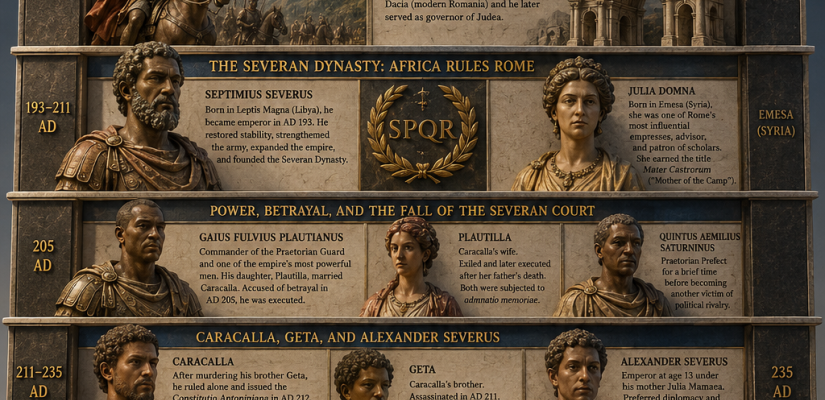
The Severan Dynasty: Africa Rules Rome
The greatest political success of Roman Africa came with Septimius Severus.
Born in Leptis Magna (modern Libya), Severus rose through Rome’s military and political ranks before becoming emperor in AD 193.
An accomplished soldier and administrator, he restored stability after years of civil war, strengthened the Roman army, expanded the empire, and founded the Severan Dynasty, one of the most influential ruling families in Roman history.
Although born in Africa, Severus considered himself entirely Roman. His reign demonstrated that the empire rewarded ability and leadership rather than birthplace.
Standing beside him was one of Rome’s most remarkable women Julia Domna.
Born in Emesa modern Syria she became one of the most influential empresses in Roman history. She accompanied military campaigns, advised her husband on political affairs, and became a patron of philosophers, jurists, and scholars. Her influence earned her the title Mater Castrorum Mother of the Camp reflecting the extraordinary role she played within the imperial court.
Power, Betrayal, and the Fall of the Severan Court
Among Septimius Severus’ closest allies was Gaius Fulvius Plautianus, another Roman from North Africa who rose to become commander of the Praetorian Guard.
As Praetorian Prefect, Plautianus became one of the most powerful men in the Roman Empire, second only to the emperor himself. To strengthen the alliance between their families, Severus arranged the marriage of his eldest son, Caracalla, to Plautianus’ daughter, Plautilla.
The marriage, however, quickly deteriorated.
Caracalla reportedly despised both his wife and her father. In AD 205, Plautianus was accused of plotting against the emperor and was executed. Shortly afterward, Plautilla was exiled and, after Caracalla became emperor, she too was executed. Both were subjected to damnatio memoriae, the Roman practice of erasing a person’s memory from public life by destroying statues, removing inscriptions, and defacing portraits.
Another African official, Quintus Aemilius Saturninus, briefly served as Praetorian Prefect before becoming another victim of the dangerous political rivalries that surrounded the Severan court.
Caracalla, Geta, and Alexander Severus
When Septimius Severus died in AD 211, he urged his sons Caracalla and Geta to rule together and preserve the unity of the empire.
Instead, rivalry turned into one of the most infamous family tragedies in Roman history.
Only months after their father’s death, Caracalla arranged the assassination of Geta while he sought refuge with their mother, Julia Domna. Following the murder, Caracalla ordered his brother’s name, portraits, and public image erased throughout the empire.
Despite his violent reputation, Caracalla also introduced one of the most significant legal reforms in Roman history. In AD 212, the Constitutio Antoniniana granted Roman citizenship to nearly every free inhabitant of the empire, forever changing the relationship between Rome and its provinces.
The Severan dynasty continued through Alexander Severus, who became emperor at only thirteen years of age under the guidance of his mother, Julia Mamaea.
Unlike many of his predecessors, Alexander preferred diplomacy over warfare and governed with the advice of experienced senators and legal scholars. His moderate leadership, however, failed to satisfy sections of the Roman army.
In AD 235, Alexander and his mother were murdered by mutinous soldiers, bringing the Severan dynasty to an end and ushering in the turbulent Crisis of the Third Century.
Christian Rome Saint Augustine
As Christianity spread throughout the Roman Empire, North Africa emerged as one of the greatest centers of Christian learning and intellectual life. Its cities became home to influential bishops, scholars, and theologians whose ideas would shape the future of Europe.
The most celebrated of them was Saint Augustine 354 430 AD born in Thagaste modern Algeria
Originally trained as a rhetorician, Augustine spent years searching for truth before converting to Christianity. He later became Bishop of Hippo, where he devoted his life to preaching, writing, and defending the Christian faith.
His masterpieces, Confessions and The City of God, became two of the most influential works in Christian history. Through his writings, Augustine transformed Christian theology, philosophy, and ethics, leaving a legacy that continues to influence Western thought more than sixteen centuries later.
The Renaissance: Alessandro de’ Medici
Centuries after the fall of the Roman Empire, people of African ancestry continued to appear in Italian history.
One of the most remarkable examples was Alessandro de’ Medici 1510–1537 the first Duke of Florence and a member of one of Renaissance Italy’s most powerful families.
Contemporary descriptions and portraits suggest that Alessandro had African ancestry through his mother, making him one of the earliest Renaissance rulers believed to have mixed African heritage.
Officially, Alessandro was recognized as the illegitimate son of Lorenzo II de’ Medici. However, even during his lifetime, many believed his biological father was Pope Clement VII, although historians have never reached a definitive conclusion.
With the support of Clement VII, Alessandro became Duke of Florence in 1532, strengthening Medici rule over the city before being assassinated by his cousin, Lorenzino de’ Medici, in 1537.
from Saint Augustine, whose writings transformed Christian thought, to Alessandro de’ Medici, the first Duke of Florence, people of African origin helped shape the history of Rome and Italy across more than 1,700 years.
Copyright 2018 Eden Walks
Eden Walks is Part of Follow Me Tour
Website made by Rekuest Web Agency
 send message